Three and Counting ...5
A Study of the Repeating 3s Phenomena
| Home Page | Addendum | Page 2 | Page 3 |
| Page 4 | Page 5 | More Threes Examples | AI 3s and 2s |
3s Enthusiasts as of June 6th, 2025

"Threes" discussions about Literary-focused contexts typically exclude examples from various Science-defined subjects; and therefore sets the stage and scripted dialogue which instigates a stark absence for any initial and further consideration of this very important Anthropological, Linguistic, Psychological, and Sociological Phenomena; thus resulting in a misunderstanding (and the creation of false assumptions) about the recurrence of threes as an expressed cognitive pattern (among others) that continues to be repeated in Multiple contexts... as well as why it is repeatedly absent from other contexts. Its absence is as much a telling point about human cognitive development and application as is the recurring presence of "threes" in its multiple forms and the symbology being employed. It's importance becomes magnified into a greater clarity when we:
- Contrast it with the histories of Monism, Duality, and Plurality.
- Identify and consciously acknowledge the presence of a 1-2-3 maturational development sequence.
- Become aware of the repeated mis-labeling of the 3-to-1 ratio as a "four" (quaternary, quaternion, etc...) pattern.
|


|
 |
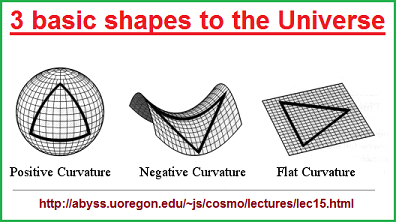 |
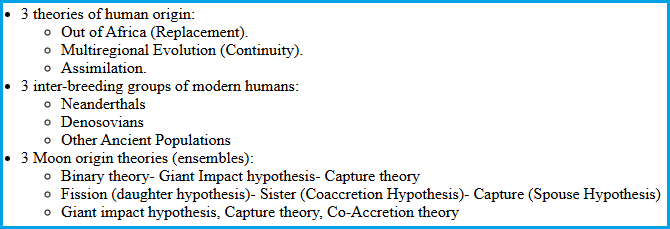 |
When "threes" examples are listed, the recurring pattern of most collectors is to list those from a give subject such as the triads of ancient Egyptian religion, mythology, Fairy tales, or some other specific and specialized genre of interest such as writing speeches, children's stories, science fiction, advertisements, etc... Hence, it is rather easy to compile the list under a singular heading. However, if you are a collector surveying multiple subjects, your first inclination may be to label the examples under the specific type of subject such as Anatomy, Physiology, Physics, Biology, Cartoon figures, Psychology, etc... However, these categories are reminiscent of the efforts used by Librarians in the adoption of one or another classification system comprising Inter-national, National, and regional focuses. However, one might reference three standards:
- Dewey Decimal System:
- Developed by Melvil Dewey in the 1870s, this system is widely used in public libraries and K-12 school libraries. It organizes books into ten main categories, each represented by a three-digit number, allowing for further subdivision into more specific topics. This system is currently used in approximately 200,000 libraries across at least 135 countries.
- Library of Congress Classification (LC):
- Most academic libraries in the United States utilize the LC system, which is more complex and better suited for the extensive collections found in universities and research institutions. The LC system uses a combination of letters and numbers to categorize materials, making it more flexible for larger collections.
- Current Trends:
- While the Dewey Decimal System remains prevalent, there is a growing movement among some libraries to adopt alternative classification methods. For example, some libraries have started using systems that categorize books (or DVDs, etc...) by subject rather than by number, aiming to create a more engaging and user-friendly experience for patrons. Libraries like the Rangeview Library District have implemented their own systems inspired by bookstore layouts, which prioritize subject-based organization over numerical classification.
With respect to categorizing multiple examples of "threes" from multiple subjects, we are dealing with a specificity of human cognitive activity that has been largely taken for granted and viewed dismissively by those whose underlying world-view orientation is based primarily on dualities such as with Mathematics and Psychology, and noted as a persistence of dichotomization, which is appreciably tragic if human consciousness has the potential of developing into what might be described as a "third consciousness", in concert with the underlying initiatives of a similar developmental trend having occurred on basic levels of biology such as the now standard triplet code of DNA thought to have arisen from a singular than double formula, and the complexity of development having occurred with the 3 Germ layers, which also arrived by a developmental 1-2-3 process. Indeed, if you have a child that is experiencing an unrecognized developmental shift into some measure of a 3rd consciousness but there is not academic sensibility or sensitivity to such a possibility, then the typical response is to medicate the child, to place them in some "special" classroom or course so that they can be "normalized" into a society dominated by professionals whose training and day-to-day world-view is oriented to the old standard of dichotomization... whereby they must seek out for themselves an activity, a group... legal or otherwise, that best provides for some measure of acceptance to their "non-normalness".
Why shouldn't there be an increased rebelliousness not only among the very young, but older populations as well? Why shouldn't there be a growing trend away from religion with its antiquated patterns of viewing the world in dualities, and whose only "thinking outside the box" efforts are to utilize existing dualities to formulate some makeshift trichotomy which is little more than an embellishment of the old system of dualities! The current Western religions and Eastern philosophies and prevailing institutions of government, business, and multiple academic genres are inadequate for addressing issues for a context of developmental consciousness they are wholly unprepared for. Instead, let us continue to allow such institutions to perpetuate a cycle of nonsensical policies, practices, and laws which create conditions which leave the people no choice but become non-compliant and thus forcing the established systems of dichotomy to retaliate with force to incarcerate, maim, or kill to its satisfaction. The underlying cause of so much conflict is due to the development of a third consciousness confronting a system of practiced and enforced duality. Yes, see them in their two-pattern rhetoric: DO or DIE, My way or the Highway, Black/White, Heaven/Hell, slow/fast, All or Nothing, Nature/Nurture, yin/yang, binary computer language, etc...
Where and how the "3" is used representing the X-tra ordinary or some metaphysic when applied to notions of spirituality: (Suggesting humanity has the potential to increase its third consciousness development already taking place.)
- The wide spread view that it's a magical number. (i.e. "super"-stition)... No other number has this widespread
distinction in so many contexts.
- Death occurs in threes (There exists no evidence other than for the recurrence of the perception thereof.)
- 3 on a match (WWI idea related to the time needed for sniper to get a bead on a target.)
- 3rd time's the charm (Recurring evidence for the expression, not necessarily the deed... Somehow it is thought that 2 wrongs or bad events somehow meld into a favorable one.)
- 3 AM is the time when Victorian Era bakers were required on the job. This moment in time is singled out though the work-day may have begun at 11 PM the previous day and lasted beyond the 3 AM historically noted time of reference.
- 3 or fewer alcoholic drinks per day is consider the average or normal quantity while 3 or more drinks is the standard recited quantity for issuing medical cautions and warnings.
- Less then three (typically 2) pills are the standard quantity marked on over-the-counter prescription medications.
- 3-drug standard U.S. used lethal injection protocol is involves 1) an anesthetic to render the inmate unconscious, 2) a drug to paralyze the inmate, and 3) a drug to stop the heart.


- Three Hares Circular Motif is considered "Universal" by showing up in a string of cultures, but actually describes a biased review:
- China: The earliest known depictions of the motif can be found in the Mogao Caves, dating back to the Sui dynasty (6th–7th centuries).
- Middle East: The motif is also found in sacred sites from the Middle East.
- Devon, England: Known as the "Tinners ' Rabbits," this motif is used as an architectural ornament and a religious symbol in Devon, England.
- Europe: The motif appears in historical synagogues in Europe, particularly in Devon, England.
- 3-colored stoplight is the standard in most parts of the World as of this Nov. 7th, 2025 Date.
- Between you, me and the fencepost. (Embellished duality advancing a state of secrecy to be kept; used as a triad expressed by older generations.)
- 3 common comparisons in Soccer: Strong versus Fast versus Smart players
- Luck comes in threes is a common expression. No other number is used with as great a frequency in Western Cultures.
- Death occurs in threes is a common expression in western cultures, though it also is widely disputed.
- Rule of three: (Dominant acceptance of an effect to be applied in multiple contexts. No other number is used as often or as broadly.)
- Adoption by Western Religions, Eastern philosophies, Metaphysics, Sports, Entertainment, Science, etc... as having a special power or reference.
- (The three is said to) Symbolize Harmony of two opposing positions. (This is an act of creating an embellished duality, and not a true trichotomy.)
- As a geometric form, (the three) is said to conduct or focus some measure of energy such as sitting under a triangle or using multiple over-lapping triangles to express power such as in the creation of a star (law enforcement badge), or interconnect linear models such as a pentagram (witchcraft) or pentagon (U.S. military complex) or triadic ensembles of people to produce something good or something bad.
- Superposition, in physics represents more than two states simultaneously.
- The position beyond "2" is sometimes referenced with different words or symbols: many, more, much, few, some, ...
- 3-point shot in basketball. (There are no 4 or more point shots.)
- 3 strikes and you're out in baseball. There are no four-strikes, but foul balls do occur.
- 3-person limit used by the Nobel prize committee for awards.
- 3 standard Olympic medals.
- Three-peat distinction in sports.
- Triple threat distinction typical in performing arts.
- Tripartite Aspects of Masonic Beliefs:
- Brotherly Love: Fosters harmony and unity
- Relief: Emphasizes charity and philanthropy
- Truth: Inspires an unceasing quest for wisdom, self-reflection, and integrity in thought and deed.
- Three tenets of Obligation:
- Morality: Through the pursuit of truth, Masons continually refine their ethical compass and strive to live upright lives.
- Charity: Guided by relief, they devote time and resources to philanthropic projects, embodying the Craft’s commitment to helping the vulnerable.
- Obedience and Harmony: Brotherly love extends to respecting laws, customs, and the dignity of all, promoting social cohesion and civic responsibility
- Three tenets of Obligation:
- Freemasonry’s Journey by way of three degrees: Entered Apprentice, Fellow-craft, and Master Mason.
- 3 symbolic pillars of every Masonic lodge: Wisdom, Strength, Beauty.
- 3 Masonic symbols (square, compass, and letter G) conveying deeper philosophical truths.
- 3-axis, 3-allies distinctions perpetrated by journalism in WWII.
- 3rd Reich of Hitler
- Trinity in Christianity, Trimurti in Hinduism, multiple threes in Eastern philosophy.
- Super-positions of 3 demarcated by a comma in value notation. (ones-tens-hundreds, thousands- ten thousands- Hundred thousands,...)
- Colloquial references of time: seconds- minutes- hours; days- weeks- months; ...
- Human female pregnancy: 3 trimesters
- 3-part human anatomy (not including the several triads): List of 3s in Anatomy
- Groups of Gods and Goddesses labeled as triads, trinities or even tritheism. (Religion, Mythology)
- Groups of Angels and Multiplicities... 3-6-9-12...
- 3-fold rule in witchcraft (Today's Wicca involving 3 forms of Hectate: Maiden- Mother- Crone).
- Groups of demons and monsters.(666, 3-headed dog Cerberus, 3 furies...)
- Groups of demon/monster children born from Gaia (mother earth is a monster breeder).
- Superior development (i.e. 3 germ layers, trilaminar cell (called bi-lipid)...)
- Superior construction (i.e. DNA triplet code, 3 particle families...)
- Organizational strategy (i.e. Military)
- Taiwan Unveils Three-Tier Drone Strategy to Boost Defense Readiness by Christine Casimiro
- China’s 'Three Warfares' in Perspective (concepts of public opinion warfare, psychological warfare, and legal warfare) by Peter Mattis
- The U.S. Marines use the "rule of three" to organize their operations and strategies. This principle means that each Marine has three primary tasks or goals to focus on, which helps them stay organized and avoid confusion. This organizational structure is applied across various levels of the Marine Corps, from corporals to generals, ensuring that Marines can effectively manage their responsibilities and respond to situations efficiently.
- 3 Barley corns: Under the 1300 (AD) Composition of Yards and Perches, one of the statutes of uncertain date that was notionally in force until the 1824 Weights and Measures Act, "3 barly cornes dry and rounde" were to serve as the basis for the inch and thence the larger units of feet, yards, perches and thus of the acre, an important unit of area. The notion of three barley-corns composing an inch certainly predates this statute, however, appearing in the 10th-century Welsh Laws of Hywel Dda.
- Superposition on bipartite structures:
- Yin/Yang... I Ching triads (are actually embellished Dyads/Byads)... Yin-Unity-Yang is an internalized duality.
- Dualities of Psychology rendering tripartite ideas (e.g. Id-Ego-Superego idea, Triune brain theory, triune love theory...)
- Dualities of Mathematics rendering tripartite ideas (e.g. trigonometry, Boolean algebra, Pythagorean theorem)
- Binary computer language... ternary/trinary quantum computing being attempted.
- Bipedal gait... auditory tripartite structure for equilibrium (e.g. 3 semi-circular canals)
No one is discussing the exhibited efforts to move from dichotomies to trichotomies as a reflection of an underlying biologically crafted impulse of developmental cognition. Chemistry from which biology arose, had to adapt to the primary patterns of the early Earth environment, one of which was not only the 2-patterned night/day photo-affecting sequence, but also the 3-patterned dawn- noon- dusk sequence in relation to an accelerated rotating 3rd planet Earth where photo-periodic moments played a crucial role from which photo-receptive life arose. Early life acted like an impressionable artist, not an analytical chemist.
Origination: Friday, June 6th, 2025... 12:48 AM
Date of initial posting: Friday, June 6th, 2025... 5:27 AM
Posting of this section:Saturday, Nov.29th, 2025... 6:32 AM
Contact: herbobuckland(-at-)hotmail.com